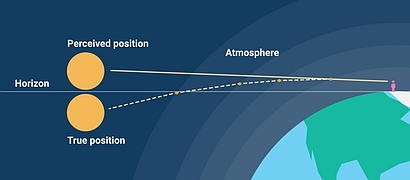
The news media often have reports mentioning the spring and autumn equinoxes but what they usually don't add is that the name "equinox" is rather a misnomer as it implies that the durations of day and night on those days are equal, which is not actually the case. But why is this so, and are there any days (called "equilux" days, for "equal light") when the durations are in fact the same?
There are two reasons why the durations are not the same. Firstly, sunrise & sunset are conventionally defined relative to the upper edge of the Sun rather than its centre. So, sunrise is when this edge just appears above the horizon and sunset is the instant this edge finally vanishes below the horizon. "Daytime" is defined as the time difference between these two events. This is clearly a longer duration than if those events were defined relative to the geometric centre of the Sun's disc.
| Secondly, because the variation of the density of Earth's atmosphere with height bends the path of the light coming from the Sun (a process called refraction), when the Sun is very near to (or below) the horizon it will be seen quite a bit higher in the sky than it actually is - see the diagram below. | ||
| The effect of refraction is to make the Sun appear to rise earlier and set later than it actually does, thus further increasing the duration of daylight - in fact it has about twice the influence of the "limb vs. centre" differential. Therefore, the average day is always going to be longer than the average night - by about 34 minutes, in fact. It is also true that the longest day (16hrs 47min 30sec at the June solstice) is longer than the longest night (16hrs 18min 30sec at the December solstice), a difference of 29 minutes. | |
| This diagram illustrates those two factors in operation. The apparent diameter of the Sun is about 32 arc-minutes (just over half a degree) so when it is about to rise according to the conventional definition i.e. its upper limb is about to appear above the horizon, it has to rise a further 16 arc-minutes before its centre point appears to sit on the horizon, as required for a scenario in which the duration of day & night would be equal at an equinox. However, at sunrise or set it is actually about 34 arc-minutes below where it appears to be because of refraction. It therefore has to rise a total of about a further 50 arc-minutes after the instant it is seen to have just peeped over the horizon before it can be said to have truly risen. | 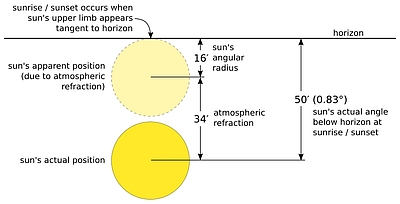 |
To see if this theory accords with practice (that the June solstice day is 29 minutes longer than the December solstice night) we firstly need to note that, as the geometry of the Sun/Earth orientation is what one might call "inversely symmetric" at the solstices i.e. the Earth's axis is leaning towards the Sun at the June solstice the same amount as it is leaning away at the December solstice, the arc of light traversed by a place on Earth in June will be equal to the arc of darkness traversed in December. Therefore, all other things being equal, the June day should be the same length as the December night. Given that this is not case in practice, any difference must be due to the factors mentioned above.
Time for a bit of arithmetic, therefore! To calculate the time the Sun takes to rise or set the extra 50 arc-minutes we need to know how long the Sun takes to fully rise or set on those days, together with the exact diameter of the Sun at that time. We can then calculate the Sun's speed of rise in seconds per arc-minute and thus determine the time for it to move the entire "limb vs. centre plus refraction" distance.
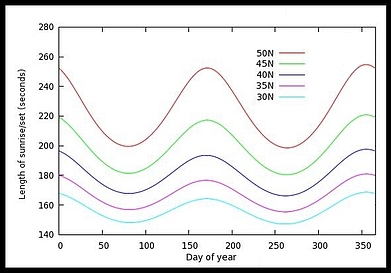 | The diagram above sort of implies that the Sun rises vertically, which is clearly not true in the UK. Because the Earth's axis of rotation is tilted (at 23.44 degrees) the Sun actually rises or sets at an angle to the horizon, and the time it takes to do so depends on the day of the year and on latitude - this diagram shows the variation for different values of latitude. Calculating the rise time for any particular day at any given latitude is rather complicated, but at the solstices this time is closely equal to 142/cos(1.14 x L), where L is the latitude. In my part of the UK this comes to about 280 seconds so the Sun rises (or sets) at about 8.7 seconds per arc-minute and would thus take 7.25 minutes to rise the 50 arc-minutes. Now of course the June longest day has an early sunrise and a delayed sunset to take into account, both of which make it longer, and the December longest day has a delayed sunset and an early sunrise, both making it shorter. The time given above must therefore be multiplied by 4, to give total time difference of 29 minutes - exactly as found in practice. The theory thus seems to work! |
And just to note that although the amount of solar refraction varies greatly with the Sun's altitude, the value given above (34 arc-minutes) is appropriate for the case when the Sun is very near the horizon i.e. when it is rising or setting, as in the case we are considering.
Reverting back to the consideration of equilux days, a further factor we must take into account when looking for an equality of daytime and night-time is that, as everyone is well aware, (and again because of the Earth's axial tilt) the relative lengths of day and night vary throughout the year and according to one's latitude to a degree much greater than the effects noted above.
| The variation is shown by the this graph which displays data calculated for my location by using a webpage provided by the US Navy Astronomical Applications Dept. (which I have found to be generally accurate). If only the axial tilt effect were in operation, the duration of day and night would indeed be equal at the equinoxes as on these days the tilt of the Earth's axis has no effect as it is neither pointed towards nor away from the Sun. However, because of the limb vs. centre and refraction effects mentioned above, each equinox in fact has a slightly longer duration of daytime than night-time. | 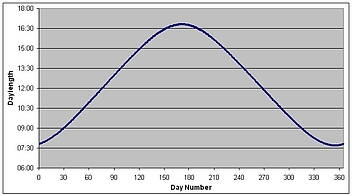 |
But now we know why "equinox" is in fact not an accurate description we can move on to the second part of the question - are there any days when daytime and night-time are equal? An extension of the above graph, adding in the night-time duration, can help us here.
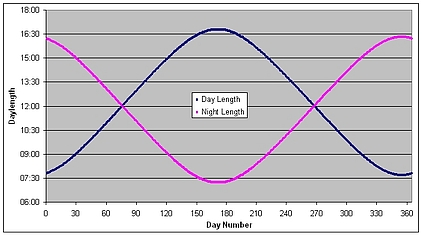 | Note firstly that it confirms, as calculated above, that the longest day is longer than the longest night (the highest point of the blue curve is higher the highest point of the purple curve), and also shows that the shortest day is longer than the shortest night (the lowest point of the blue curve is higher than the lowest point of the purple curve). Taken together, these results account for the fact that the average day is longer than the average night, as stated above. |
The most important thing to note though is that the points where the graphs cross each other are exactly on the 12 hours duration line i.e. there are in fact two equilux days in the year, when daytime and night-time are equal. These days are slightly before the spring equinox and slightly after the autumn equinox. Click or tap on the graph to put in markers - green for spring and blue for autumn. A closer look at the placement of the markers will show that both sit slightly above the intersection i.e. there is slightly more daytime than night-time at both equinoxes, as previously deduced - about 11 minutes in March and 12 minutes in September (less than the per-day figure of 14.5 minutes we found in the very first calculation because the Sun rises more quickly at the equinoxes than at the solstices).
Note also though that the day length of days before the spring equinox is shorter than for the days after it, and the reverse is true for the autumnal equinox. We can thus equalise things by moving nearer to the beginning of the year in spring and nearer to the end of the year in autumn. The reduction in day length thus achieved will then balance out the increase caused by the "limb vs. centre" and refraction effects, equalising the day and night lengths. The spring equilux is thus before the vernal equinox but the autumn equilux is after the autumnal equinox.
The number of days an equilux is before or after an equinox again depend on one's latitude (as that determines the change in day length per day), but is usually 3 calendar days in the UK. In 2025 the vernal equinox was at 09:01 on 20th March and the equilux was on the 17th. The natural decrease in day length going back from the 20th to the 17th was 12.28 minutes, slightly over-compensating for the "limb plus refraction" increase. Similarly, the autumnal equinox was at 19:19 on 22nd September and the equilux was on the 25th. The day length decreased naturally by about 12 minutes between these two dates, almost exactly compensating for the "limb plus refraction" increase. In general, the compensation will rarely be exact as of course one must deal with whole days. So, while at the March equilux the day length ended up a minute or so less than 12 hours, in September it was indeed almost exactly 12 hours long. No other "calendar day" had a day length closer to the exact 12 hours though, as shown by the graphs below.

Incidentally, you might have noticed I have used the term "about" quite a few times in the above explanations. This is because while all the calculations underpinning my conclusions rely on a knowledge of such things as the times of sunrise & sunset it has proved frustratingly difficult to find consistent listings of same. Values from different sources often differ by several minutes even when they were supposedly calculated for my location. Also, even when I found values I felt I could trust they were often quoted without the seconds part and so, even if the minutes were rounded to take the missing seconds into account, they could still be imprecise by about half a minute. I have thus resorted to using the astronomy program C2A to show a view of, for example, sunrise or sunset and stepping forward in small increments of time (down to 1 second at a time) while observing the position of the Sun against the plotted horizon line. Even this approach has produced some results which I'm not quite sure about, but I feel it is the best I can do in the circumstances. As a consequence, although I feel that my conclusions are correct they may not be accurate to the exact minute and second.
