The UK enjoyed a particularly warm & settled period just before the Venus-Jupiter conjunction but, predictably enough, the weather took a turn for the worse as the day of closest approach (9th June) drew near. I was therefore not confident I would see anything at all, as dark skies and sudden torrential downpours became the norm. These conditions did produce some lovely rainbows though! Add to this the fact that I would be out on the evenings of 9th & 10th and it seemed that opportunities for a good view would be decidely limited.
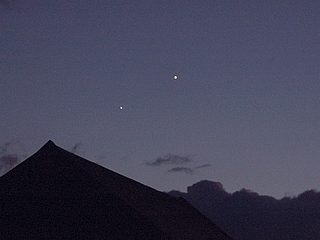 |  | However, I had noticed that although the early evenings were "changeable", there was a tendency for skies to clear somewhat later on. And sure enough, after a rainstorm of monsoon proportions (with added hailstones!) on the 8th conditions improved during the later evening, enabling me to see the pair from an upstairs window. This viewpoint was not suitable for photography though so I waited until they sat between the two houses over the road from my back door. And this is what I saw - the view at almost 10:30pm on the evening before minimum separation. Jupiter, left, and Venus, right, are very clearly seen just above a cloud-bank on the horizon. The separation was 1deg 50min 37sec. |
| The grey disc I have included above, and also with the other pictures below, is there to give a sense of scale as otherwise it would not be possible to judge how the conjunction would actually have looked in the sky. In all cases, the disc is the same size as the Full Moon would have been had it been visible that night. For those who have viewed my other pictures of planetary conjunctions on the previous page, I would note that the discs here are much smaller than those there as I wished to include some context to this conjunction and so these images are shown with a more wide-angle view than used previously. I have thus reduced the size of the moon disc to maintain the correct relative sizing. | ||
| Happily, my luck then held the next day as skies again slowly cleared as I drove back home from a choir rehearsal. Not as much as on the 8th, but enough to indicate that I might be able to see minimum separation after all. There was still some cloud about though, with lots of "wispy stuff" nearer the horizon, so I decided to stop and take some insurance shots as I was passing through the grounds of our local stately home, Heveningham Hall, as shown here on the right at 10:22pm. | | 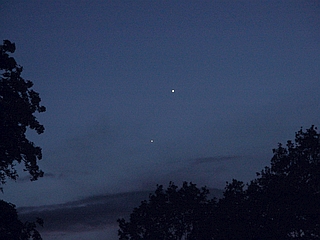 |
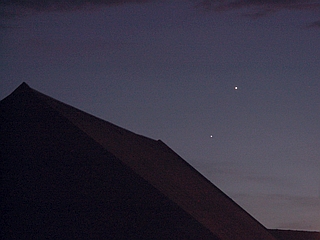 | | The planets were lower in the sky by the time I got home but I was still able to capture them from the same position as on the 8th. Here they are at 10:42pm with the same neighbour's roof as before. While the orientation of the planets in both these images is clearly different from that on the 8th, it is not all that obvious that the separation is any less. In fact it is only slightly smaller, at 1deg 36min 28sec. |
There was no chance to see the conjunction during the next two evenings as on both occasions the cloud stubbornly refused to dissipate. I wasn't that concerned though, as of course the conjunction was widening with each passing day. However, skies were substantially clear on the 12th. This encouraged me to don something warm and venture out to see if I could capture Mercury, rising out of the twilight as it approached eastern elongation, as well as Jupiter and Venus. It would, in theory, have been visible on the 8th & 9th but the low cloud would have meant it couldn't actually have been seen. As usual with low-lying targets, I had the problem of balancing altitude with exposure - the longer one waits for the sky to darken the lower everything gets! It's thus often a case of fire off a lot of shots at various exposures in hopes that something will come out.
I got to my usual viewpoint in the nearby allotments reasonably early and was able to pick up Mercury in binoculars, thus giving me some idea of where it would be in the sort of wide-angle shot necessary to capture all three planets. I thus got snap-happy for the next 35 minutes, guided by what I could see in the binoculars, until it was clear that my quarry was now too low. It was then a case of seeing what I had got! In fact, when I examined the images later Mercury was visible (after enhancement) in quite a number of them, the best view being one taken quite early on before it had descended too far into the orange twilight glow.
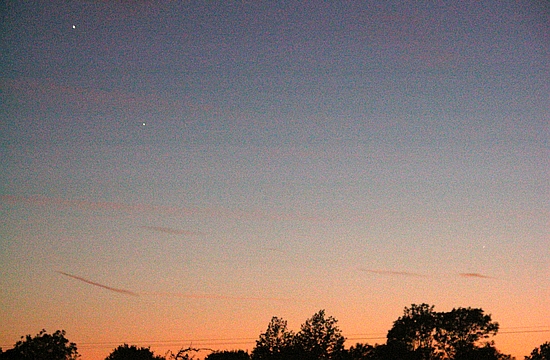
Mercury can be seen at bottom right, just above the furthest-right cloud fragment and about as far above the cloud as the cloud is above the tree. It was 5 degrees high, at magnitude 0.34 according to astronomy program C2A.
It was then cloudy on the 13th, and I doubted whether I would be able to capture anything on the 14th because I was out that evening. However, I got home a little earlier than anticipated so I quickly assembled my camera plus tripod, grabbed the binoculars, and hurried off to my usual viewing site, arriving at around 10:35pm. This was much later than on the 12th, which meant everything would be much lower in the sky. I did manage to pick up Mercury in binoculars though so fired off a few quick shots. Only the first of these showed anything, but the small speck was in the same position as indicated in the binoculars so I assumed it was Mercury. After a bit of processing, this was what I got:-
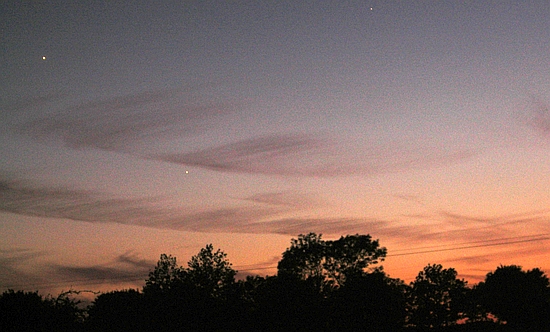
If you now look below the wires at the bottom right-hand corner, you should see Mercury sitting on the top edge of the left part of the linear cloud fragment coming in from the right-hand edge of the image, just above a pair of "rabbit ears" projecting out of the bush to the left side of the dip in the treeline. Yes? Not staggeringly obvious, but it is there - just under 3 degrees high at magnitude 0.46. Nice display of wispy, feather-like, clouds in the rest of the frame, I felt. The star visible at the top of the image, to right of centre, is Pollux in the constellation of Gemini.
Note that although the two images above are to the same scale as each other, this scale is much greater than for the images of the conjunction itself because of the much greater distance between Venus and Mercury as compared to between Venus and Jupiter at conjunction.
It was cloudy again on the 15th & 16th, and by the 17th Mercury was so low down that by the time I returned home after an evening rehearsal it had already set. In any case, at magnitude 0.65 it would have been difficult to capture. I thus decided I would deem this conjunction to be fully observed.
However! There was another conjunction to focus on that evening, this time between Venus and the Moon - a very close one too. Indeed, from some parts of the world the Moon had actually occulted Venus, a meeting clearly visible despite the fact that it occurred during daylight. No such luck here, but the view was quite dramatic. Clear skies allowed me to keep it in view during my drive home but by the time I arrived the pair were rapidly nearing the horizon. I thus dashed out with camera & tripod to see what I could get.
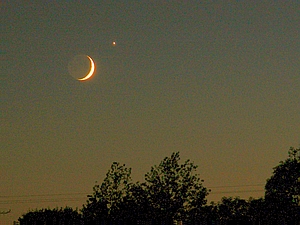 |  | 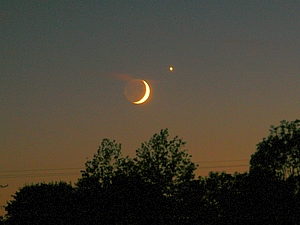 |
Here we have the view at 2 minutes to 11pm and 6 minutes past respectively as the pair sink slowly into the western twilight, shown at the same scale as other lunar conjunctions on the previous page to illustrate how close this conjunction was. Note that the whole of the Moon's disc is faintly illuminated by Earthshine, being sunlight reflected onto the Moon by the Earth. The centre-to-centre separation between the Moon and Venus at this time was just 52 arc-minutes (a bit less than one degree), the minimum being 39 arc-minutes one hour previously - the closest evening conjunction involving the Moon since that with Saturn way back in 2007 (see previous page). That was nothing like as dramatic though, Saturn being much less bright than Venus.
And that was the end of the show! A much better set of results than I had initially feared, I have to say.
