 January 2026
An aurora is a natural light display produced when an increase in the speed and intensity of the solar wind causes energetic particles trapped within the Earth's magnetic field to impinge upon the upper reaches of the atmosphere. In so doing, they collide with the gas molecules which make up the atmosphere, ionizing and exciting them. When these molecules revert to their unexcited state they release the additional energy in the form of light. Different atmospheric constituents require different amounts of energy to excite them, and so they release different amounts of energy when they revert to their former state. The wavelength of light (that is, its colour) depends on the amount of energy it holds and so these different releases of energy produce light of different colours.
The Earth's magnetic field is similar to that of a bar magnet, with field lines running between the north & south geomagnetic poles. These are offset from the geographic poles and actually sit at latitude 80 degrees North and South. The way the speed, direction and charge of the incoming particles interacts with the magnetic field causes auroras to be seen lower in latitude than the poles themselves, in an arc about 15 to 23 degrees lower in fact i.e. at around 65 to 57 degrees latitude. This is why auroras are not generally seen in the more southerly parts of the UK or, if they are, they are being viewed from long distance.
Because the atmosphere consists mainly of nitrogen and oxygen, it is atoms and molecules of these elements which produce the colours we see. In fact, all three primary colours (red, green & blue) can be generated and these may then mix together to produce other shades. Red light is produced by oxygen atoms at high altitudes, but at lower altitudes the red emission is suppressed by collisions betwen the greater number of atoms present and so green predominates. Nitrogen takes over at even lower altitudes, emitting mainly in the blue part of the spectrum.
But enough of the science, let's have a look at some pictures! Before we do though, I must explain a few things about their appearance. Despite ideas to the contrary gleaned from photographs of auroras, when seen from much of the UK they are in fact generally not particularly bright when viewed by eye. This is particularly true of any red sections, the human eye being relatively less sensitive to that part of the spectrum as compared to green. So, to capture the full effect with a camera it is necessary to use one or both of a high ISO number and a long exposure. An auroral display is not static though - the curtain-like structures tend to "ripple" and the display as a whole moves across the sky. As a consequence, a time exposure will inevitably result in the loss of some detail in the image.
January 2026
The first set were taken during the famous "Aurora Storm" of 10th May 2024 when multiple eruptions on the Sun produced the most dramatic display since March 1989. They were quite clearly visible to the naked eye, along a large part of the northern horizon and later spreading to be almost overhead. Unfortunately, later on in the evening I found I was viewing the display through thin cloud and mist, which contributed to a "lack of sharpness", shall we say. The end result is that some of my images have a definite resemblance to how J.M.W.Turner might have interpreted the scene! As to the colours themselves, the only processing I have done is to "stretch the histogram". In other words, I just increased the brightness range of the images, which enabled the darker areas to be better seen thus allowing the colours that were already present in the images to come to the fore. The end result might be considered a little un-natural in some cases but the colours have not been "faked" in any way.
 This was the view at 9:25pm, when I first ventured out. Although the sky is not yet fully dark there is clearly something interesting going on! Note the stars forming the W-shaped constellation of Cassiopeia to right of centre and the bright star Capella to far left |  Less than 10minutes later the green band has deepened in colour and begun to expand quite significantly. This view is about due north and, taken together with the previous image which looks somewhat more westward and the next one which is more eastward, it is clear that the green band is in fact an arc extending upwards from the northern horizon |
 Looking further east, I began to see a suggestion of a red patch appearing at the point where the green arc met the horizon. Note the bright star Vega to top right |  Moving still further eastwards we see the full extent of the red patch which had developed by about 9:45pm. Although quite clear on this image it was only just visible with the naked eye |
 Meanwhile, by 10 o'clock a large red area had also developed at the westward end of the arc. The star to bottom left is Procyon, the two in the centre are Pollux & Castor and the bright disc is the Moon, with Elnath to its right | |
| Unfortunately, after about 10 minutes the ambient conditions began to change drastically so by 10:25pm light cloud and mist were obscuring the scene, as mentioned in the introduction. As a consequence, if you compare the next set of images with those above you will see that the dark and sharply-defined horizon line has now become somewhat fuzzy and indistinct, with a corresponding blurring of the auroras. We thus enter the "impressionist painting" phase rather than that of scientific observation! | |
 This view is looking to the east, the dark shape to the right being the house seen above with its lights on. As with all these images, it has been "histogram stretched" to display the auroras more clearly but if you click or tap on it you will see the original image. This shows all the colours in the stretched version but less distinctly, justifying my remark in the introduction that I have simply brought out what was there anyway, not artificially added anything |
 Switching my attention back to the west, I saw this very impressive "pillar" rising up from the point on the horizon where Procyon was spotted in the similar image above. The range of colours on display was very dramatic, as was its subsequent development. Click or tap on the image twice to see it broaden out over the next few minutes |
 |  |
| The pillar continued to change its shape and colour over the next 10 minutes, almost splitting in two at one point before drawing back together again to show an almost rainbow-like spectrum of colours as the primary red, green & blue displays mixed and overlapped | |
 The display then slowly began to fade so by 10:45pm I decided it was time to return home. So here's a final view to the west, with the Moon to bottom right, a waving green curtain above and the pillar still resplendent in purple & yellow. A truly amazing sight on a (so far!) unique evening. Just a pity the conditions hadn't been somewhat clearer as the display reached its peak! | |
While it's perhaps going a bit far to invoke any similarity to the arrival of London buses just yet, having never seen any auroras my score is now twice in five months! And I suspect it could have been more because, as the second occasion made clear, auroras are actually almost invisible to the naked eye, even when dark-adapted. There were a couple of instances after May 2024 when auroras had been observed over a large part of the UK but I had not seen anything myself when this was probably because I had just had a quick look and not seen anything and so assumed they had not appeared in my part of the country. Had I tried to photograph the apparently clear sky the story might have been entirely different!
I did get my camera out on the evening of 10th October though, when another display was forecast, and was very pleased that I had because there it was, glowing on the northern horizon.
 This is my first "sighter" shot, looking due North. The bright cloud to left of centre at the bottom is neither an aurora nor noctilucent cloud but rather an example of sky-glow - from the town of Harleston a few miles away to the north-west, in fact. The aurora itself shows some signs of vertical structure and a nice gradation of colour from green lower down through yellow and orange to rosy red above. | |
 Having convinced myself there was really something there I took a series of images spanning the entire auroral arc and assembled them into this panorama using the excellent program Hugin. The Plough (Ursa Major) is nicely visible to top centre. | |
   | |
| To better appreciate the full structure of the aurora you can view the individual frames making up the panorama by clicking the arrows beneath the image above, to move either left or right. When you get to farthest left or right the view flips round to the other end. If you look carefully at the two images showing the farthest right section you can see firstly a series of dots to left centre and then a short streak to bottom left where passing aircraft have sneaked into the frame! | |
The orange feature best seen in the second frame of the sequence was quite short lived. The image to the right is a close-up view, taken just 4 minutes after the one in the sequence, when the feature has narrowed into a single column. Click or tap on the image to see the situation 2 minutes later, and again to add a further 2 minutes. By this time the feature has entirely disappeared. This is in fact typical of auroral displays, which are quite dynamic both in colour and structure. |  |
 | Here's another example Click or tap on the image to see the red column hop rightwards in just 3 minutes (or, more likely, one column disappears and another comes into being as the colours are somewhat different). |
 The parting shot. A somewhat wider angle view than the ones above so you can see that in just a couple of minutes more the orange feature in the second of those images has now doubled up and moved further right. This is the last one I took before noticing that not only had there been a potential problem with my camera setup but also that the battery was about to expire! I thus quickly corrected the problem (see below), took a short series of wide-angle views so I could construct another panorama, and then headed home. | |
 And this is the panorama I made, again courtesy of Hugin. You will note that the orange feature has moved even further right in the seven minutes which had elapsed after I took the final image above. Also of note is the fact that this panorama is not as "colourful" as the first one, but there is a good reason for that! It's all a question of camera sensitivity. | |
The "potential problem" I mentioned just above was discovering that, following some daytime picture taking, I had accidentally left the camera set to ISO100 - a very low sensitivity not really suitable for astrophotography because of the generally low brightness of astronomical objects. "But the images look fine!", you may say. Ah yes, but only because I applied the "Auto adjust colors" option to each of them using my preferred image processing program, IrfanView. In the case of the three images used for the second panorama I set the camera to the rather more sensible ISO400, which effectively gave me four times the exposure without the need to increase the exposure time - which I could not do in any case because I was already using the maximum duration of 30 seconds. This is the reason the second panorama is acceptably bright without further processing. Applying "Autocorrect" is still possible though - click or tap on the image to see the result. Possibly a little over bright, but as an aurora is practically invisible to the naked eye anyway it's a moot point as to how bright a processed image should be.
Which brings me to the last image in this section. Having said that an aurora (or at least one seen at lower latitudes) is "practically invisible to the naked eye" I thought I would take advantage of the under-exposure of my original images to give some idea of what might actually be seen. This is my first image, as enhanced. Click or tap on it to see an impression of how the scene actually looked to me on the night. Yes - there is something there, honest! It's difficult to give an accurate view, as of course the brightness of different displays will vary and you can't get the full effect of looking at an entire sky from just one small image, but it does capture the "slight green glow on the horizon" which is really all I saw. | |
Auroras observed from high latitudes are considerably brighter of course, simply because the observer is much nearer to them, and events such as the "storm" of 10th May benefit from increased solar activity projecting a larger number of particles towards the Earth, which not only causes a greater excitation of the upper atmosphere but also drives the auroral arc towards lower latitudes thus making them brighter for observers in the UK. It's still worth taking your camera with you though!
Despite a number of reports of auroras being seen from eastern England following the dramatic displays in 2024, I was not lucky enough to catch any of them. I was thus not particularly in the habit of looking for them myself but when images of bright displays appeared on the Internet late in January 2026, following strong coronal mass ejections from the Sun a few days previously, my hopes rose. Unfortunately, the skies had been generally overcast during this period and so I felt my chance of seeing anything was remote.
The SpaceWeather website said there might be another chance on the night after the images appeared, but nothing was visible as I went to bed so I assumed my luck was out again. However, on returning to my bedroom following a "bathroom visit" at what I subsequently found was 3:25am (!) I happened to look out of my north-facing upstairs window and fancied I could see a lightness in the sky. "Must be nearly dawn", I thought, but then realised that the Sun does not rise in the north! (not in January, anyway). "Maybe it's just the usual skyglow then" - but I had the distinct feeling it was not the usual yellow-orange colour. Hmm. As you can imagine, my desire to tog up warmly and trek up to my usual viewing site in the allotments in the middle of the night was "somewhat limited", but I did persuade myself to bring camera & tripod upstairs. A few shots showed that the glow was indeed green so I framed things up as well as I could and continued taking shots until the battery decided it was time to get back to bed. The results are shown below.
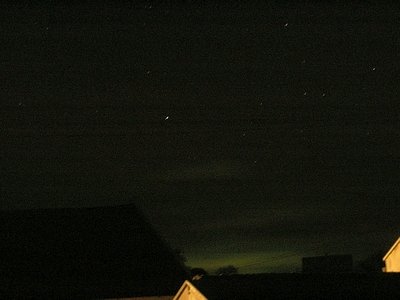 | ||
| This is essentially what I first saw, looking over and between rooftoops slightly west of North, but of course somewhat brighter than the "by eye" view as this is an enhanced version of a time exposure. Even so, the glow on the horizon is not particularly bright. It is, however, definitely green and so I was happy I was looking at an aurora. | ||
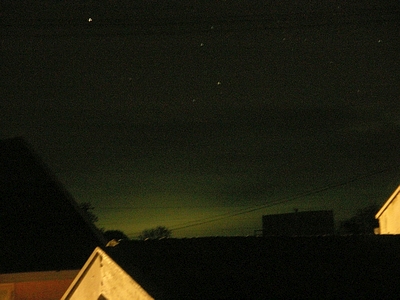 | 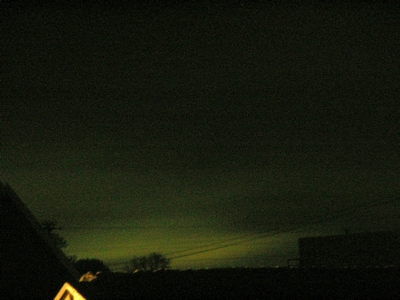 | |
| I thus zoomed in somewhat and centred the aurora (left), prior to a further zoom to allow me to take a sequence of shots of just the aurora and the area of sky above it, in hopes of revealing more colours (right). I freely admit that I have failed to identify the stars shown in the left-hand image (or indeed in the one at the top) so there's nothing more to be said there and, as shown by the right-hand image, no further colours were in fact seen. | ||
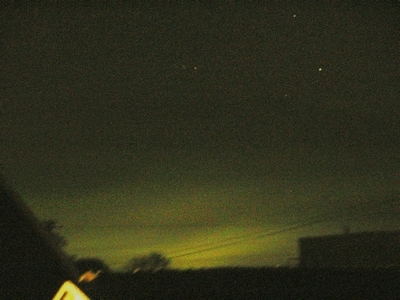 | ||
| Having taken the sequence of shots it became clear that each of them showed a very different view, both in the extent of the aurora and its brightness. To show this, I have constructed a short MP4 video which fades from one shot to the next - in "real time" this sequence would have taken about 12 minutes. To see the video, click here. As the variation was mainly due to intermittent drifting cloud rather than changes in the aurora itself, I felt the best way to show what I had seen was to combine the images into a stack using the brightest pixels from each image, as shown above. This avoids the inclusion of much of the obscuration caused by the cloud, to give a better idea of the overall extent of the display. The star pattern to upper right was brought out more clearly after stacking. It is the same as the one seen in the initial zoomed-in view but displaced to the right and downwards because of the passage of time between these images. | ||
I did take a further sequence after this one but when I looked at it later I found that the "glow" had disappeared after just a few frames. Hard to say whether this was the aurora fading away or the cloud thickening and moving in, but one way or the other that was the end of this observation.
But not entirely the end, as it turned out! The next night my body decided that 5am would be a good time to get me up and I again looked out of the upstairs window on my way back to bed. However, all I could see was a bit of grey cloud. Odd though - how could I see cloud at that time in the morning? Something must be illuminating it - an aurora? Time to grab the camera again then.
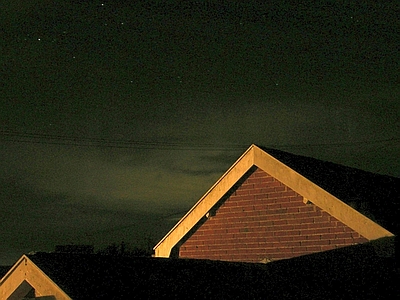 | 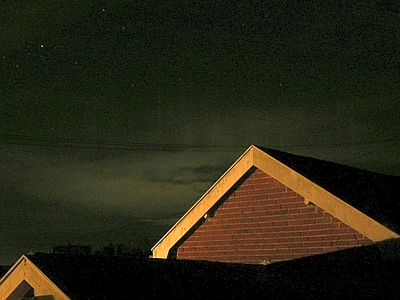 |
| I had no real idea what I might be capturing, as the sky brightness was very low, but again I took a couple of "line-up" shots and then a zoomed-in sequence. When I looked at the initial images the next day though I felt I could definitely see some vertical streaks, as shown in the images above (crossing the brighter band just above the roof-line). Now vertical lines cannot be clouds, and in fact are distinctive features of auroras! This encouraged me to combine these two images together, and also to process the sequence. | |
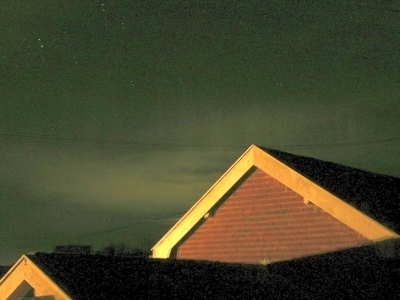 | 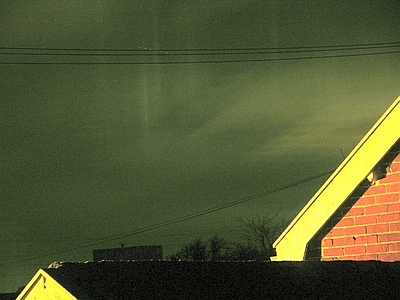 |
| On the left we have the result of combining the two images above, which has definitely brought out the streaks more clearly. More dramatically though, the image on the right shows the result of combining the frames of the zoomed-in sequence, which leaves no doubt at all that not only are the streaks real but they are clearly auroral. It also shows that the streaks must be quite static as, although the sequence of seven frames took 6 minutes to capture, the streaks are well-defined, meaning they cannot have moved significantly during this period. Seems I had my answer as to why I could see the clouds - they were illuminated from behind by an auroral display of which only the vertical streaks could be well-seen. An excellent, if rather unexpected, result I felt. | |
And that really was it for this particular display. The effects of the coronal mass ejection had lasted for about 4 days, producing bright auroras throughout north & central Europe, and I had managed (largely by accident!) to catch the end of it. Pity I hadn't looked out a day or so earlier!
