 |
|
|
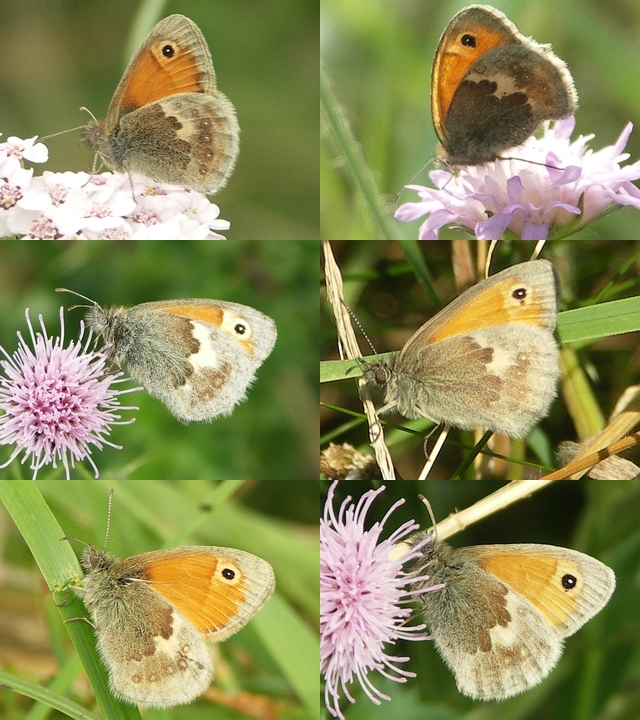
The Small Heath was not a regular visitor to Wash Meadow for many years, possibly because its usual habitat is downs and heaths. However, it does like dry light soils where a mix of fine grasses grow, which is a good description of some parts of our meadow. The first set of pictures on this page were taken in May & June 2020 and the only previous time it was seen was in June 2015. The Small Heath might be confused with the Meadow Brown, as its underwing is very similar, but it appears earlier in the year, has small spots on the hind-wing and is much smaller - note that the grass-head to the left of the centre image is only about 5cm tall. The bright-orange upper wings are rarely seen, as it always settles with wings firmly closed, but the colouration is quite clear when seen in flight - another difference from the generally brown colouration of the Meadow Brown
|
|
|
|
| Another example of the diminutive size of the Small Heath, here seen resting on blades of meadow grass in late May |
A view "contre jour" shows off the hind-wing patterning and also, at this angle, just a glimpse of the orange upper-wing surface
|
No, not an out-of-focus image but an action shot! A Small Heath caught just at the moment of take-off |
|
|
|
We were then very happy to see a Small Heath several times in 2021, as we hoped this perhaps indicated that the species was beginning to be resident in the meadow - a hope increased by the possibility that we have both male & female present. That on the left is clearly a male, given its bright orange colour, but the other two could well be female as they are distinctly yellow (and appeared less bright when in flight). Indeed, they are probably different females as their lower-wing patterns are different and the one in the centre has a dark line across its upper-wing spot whereas that on the right does not.
|
|
|
|
| In mid-September 2021 a sedum which had recently come into flower started to attract several species of butterfly, including a male Small Heath which stayed on view for much of an afternoon - must have been tasty nectar! It again seemed to be a different individual, strengthening the view that we might be developing a colony. The sedum also attracted numbers of bees & hover-flies and when they got too close to the Small Heath he flicked his wings to scare them off. This sometimes resulted in a view of the rarely-seen upper wing surface, as in the right-most image here (with abdomen of annoying bee!). The difficult bit was going to be capturing a view with the wings rather more open ...... |
| |
|
|
Like this, in fact! Not so much a brilliant shot as rather a fluke, to be honest. By chance, the shutter must have fired at precisely the correct millisecond to capture the wings fully open and virtually motionless. The colour rendition is clearly rather off, no doubt because the camera decided on the exposure & colour balance with the wings shut, but a remarkable shot nonetheless. Note the bee in the bottom-right corner!
|