
|
|
Click on any picture to view a larger version
 |
|
| Of the three common British whites, the Large White is the easiest to identify as it has prominent black wing-tips often visible in flight. The male, shown on the left, lacks the bold spots on the upper side of the forewings characteristic of the female, on the right, but those on the underside can often be seen through the wing | |
|
|
| Both sexes have underwing spots, with slightly yellowish undersides to the rear wing, as seen on these examples. The male is on the left again, recognised by the lack of spots on the upper side of the wing |
|
|
|
|
| The female lays yellow, ridged, eggs in large groups on many species of brassica (Cruciferae) - here Kohl Rabi (Brassica Oleracea). The groups are usually underneath the leaves, to reduce the chance of predation or damage, but here they were (conveniently!) on top |
After about a week to ten days the initially all-yellow caterpillars hatch out, and firstly eat the egg cases before starting on the host plant |
|
|
|
|
| The caterpillars grow steadily, shedding their skin several times (as seen in the first image here) but generally remain together in a "regiment" as a defence against predation. It is only when their distinctive yellow & black markings and the irritant hairs on their body have fully developed that they begin to separate |
||
|
|
| Particularly when fully grown, Large White caterpillars are voracious eaters, as any gardener growing cabbages will know! Here mature caterpillars are grazing on a different sort of brassica - Honesty (Lunaria Annua). The pungent mustard oil prevalent in brassicas is taken into their bodies and acts as a deterrent to predation - the yellow colour, with additional black patterning, serves as a warning |
|
|
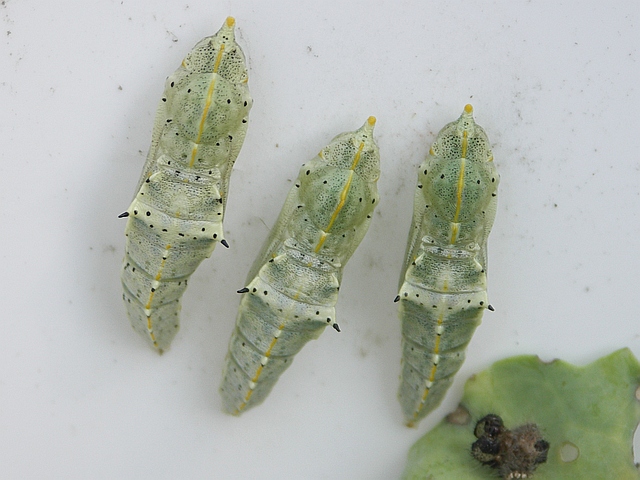 |
| The caterpillars pupate after about 3 or 4 weeks, anchoring themselves to a leaf by means of a fine thread (visible if you look at the expanded version) |
Amazingly, although a chrysalis looks "dead" it can in fact respond quite dramatically if disturbed. Click or tap on this image to see what I mean! |
|
|
|
| After a further ten days the butterfly emerges from the chrysalis - into the keep net of our "home hatchery" in this case! Chrysalises pupating in September will remain in hibernation until the following spring, however |
Newly-emerged butterfly preparing to finally depart - surrounded not by caterpillars but the pollen-bearing anthers of a sweet-corn plant! |
|
 | Return to index |


